Wednesday

Solar Grants available in FL for qualified commercial businesses

Exciting NEWS for small businesses in FL - This is a limited funded program so get your questions and soon and see if you qualify. Great time to lower your electric bills!!

CLICK Here to learn more about SUNCATCHER PROGRAM
for FL


Through a g
rant from the Governor’s Energy Office, FlaSEREF’s SunCatcher Program provides its qualified partners with grants for solar water heaters, solar electric systems and solar pool heaters. While funding lasts, solar water heater installation grants are $50/1,000 BTU of production, $60/1,000 watts for PV, (solar electric systems) and $2,500 per solar pool heater installation. Qualified partners are hotels, restaurants and condominium associations....(all HOA's)

Due to the limited funding available for this program, all grant applications require pre-approval prior to the installation of the solar energy system. Failure to request prior approval will result in a denial of the application. Click on links below for additional information and grant application.

~~~~~~~~~~~~~~~~~~~~~~~~~~~~~~~~~~~~~~~~~~~~~~~~~~~~~~~
Bob Gentile Solar Energy Consultant with Abundant Energy Inc. www.Solar-FL.com 561.732.5181
Abundant Energy Inc. is Florida's leader in Solar Energy, celebrating 23 Years of Service.
**Solar Electric ( photovoltaic ) PV
Spin your FPL meter backwards.
**Solar Hot Water
Puts you on the road to FREE hot water forever.
**Solar Pool Heating
You can now have a warm swimming pool all year round.

Thursday

Largest Solar Array in Southeast Powers Up in Orlando

Well next week is a big day for Sunny Florida :-) Congrats to Orange County Convention Center on GOING SOLAR!!

~~~~~~~~~~~~~~~~~~~~~~~~~~~~~~~~~~~~~~~~~~~~~~~~~~~~~~~~

Largest Solar Array in Southeast Powers Up in Orlando May 20th

Central Florida Mayors, Senator Constantine, Others Kick Off Green Cities Florida With Historic Unveiling

05.14.2009 – ORLANDO, FL – Florida will solidify its position as a front-runner in sustainability next Wednesday morning with the unveiling of the Orange County Convention Center’s new one-megawatt photovoltaic (PV) system, the largest rooftop solar installation in the Southeast. Solar panels will span the length of five and a half football fields, generating 1,300 megawatt-hours of electricity per year - greatly reducing the center’s carbon footprint and electricity costs.

The new PV system was made possible by a $2,500,000 grant provided by the Florida Department of Environmental Protection’s Florida Renewable Technologies Grant. Additional support for the project was provided by the OUC, EDC and US Dept of Energy bringing the total amount of funding to $8.8 Million.

SEE VIDEO HERE of Project here from FOX News

~~~~~~~~~~~~~~~~~~~~~~~~~~~~~~~~~~~~~~~~~~~~~~~~~~~~~~~

Bob Gentile Solar Energy Consultant with Abundant Energy Inc. www.Solar-FL.com 561.732.5181

Abundant Energy Inc. is Florida's leader in Solar Energy, celebrating 23 Years of Service.

**Solar Electric ( photovoltaic ) PV
Spin your FPL meter backwards.

**Solar Hot Water
Puts you on the road to FREE hot water forever.

**Solar Pool Heating
You can now have a warm swimming pool all year round.

Biggest rate increase ever by a FL utility company.

''Wow,'' said Charlie Beck of the Office of Public Counsel, which represents utility customers, when he heard the numbers. ``Wow. This is the biggest rate increase I have ever seen requested by a utility in Florida. This is really something.''
Customers of Florida Power & Light will pay a base rate of $12.40 a month more next year if the state approves the company's rate-hike request.
FPL's base rate is currently $39.31. If the request is granted, the base rate next year will be $51.71. That's a 31 percent increase.

Fpl rate increases - solar energy florida

SAVINGS IN FUEL

In a press release, FPL estimated that customers will save about $5 a month overall starting Jan. 1, but that change included anticipated declines in fuel charges. The bill of a residential customer using 1,000 kilowatt-hours a month would drop on Jan. 1 from $109.55 to $104.63, according to that estimate.

In a follow-up e-mail, VillafaƱa wrote that those numbers include an estimate from February that 2010 fuel prices will allow a bill reduction of $17.83 a month. ``Actual 2010 fuel costs could vary from this projection.''

Looks like it might be a good time to look into solar energy as an alternative to these never ending rate increases by FPL.

~~~~~~~~~~~~~~~~~~~~~~~~~~~~~~~~~~~~~~~~~~~~~~~~~~~~~~~~~~~~~~~~~~~~~~~

Bob Gentile Solar Energy Consultant with Abundant Energy Inc. www.Solar-FL.com 561.732.5181

Abundant Energy Inc. is Florida's leader in Solar Energy, celebrating 23 Years of Service.

**Solar Electric ( photovoltaic ) PV
Spin your FPL meter backwards.

**Solar Hot Water
Puts you on the road to FREE hot water forever.

**Solar Pool Heating
You can now have a warm swimming pool all year round.

Saturday

Solar Hot Water for homes saves thousands $$$ over the years!

More Realtor are now recommending home owners to invest in a Solar Hot Water System (SHW), especially here in Sunny Florida.

A house with SHW separates the listings in the neighborhood because the agent can proudly say "This House has FREE hot water"

Separate yourself from the other Realtors that say "Well you need to paint the walls and get new carpet and upgrade some appliances" YES they are all good generic suggestions but BE Different, BE Unique. BE the Realtor that says to potential buyers : "THIS House here has FREE HOT WATER" by recommending a Solar Hot Water System.
Electric bills are forever increasing and an issue/concern for many homeowners... Now you can show them a solution NOT just talk about the problem.
Recommend that they part ways from that "ENERGY HOG" called the "Electric" Hot Water tank and move over to a Solar Hot Water system... The new owner will save $70-$90 per month immediately ($80 avg. x 12 months = $960 x 5 years is almost $5000 SAVINGS and that doesn't factor in any Electric Utilities increases, so it's actually way over $5000 and probably closer to a $6000 Savings :-)
~~~~~~~~~~~~~~~~~~~~~~~~~~~~~~~~~~~~~~~~~~~~~~~~~~~~~~~~~~~~~~~~~~~~~~~~
So whether you clients are selling or just moved into a new home make this simple recommendation to them:
When you invest in a Solar Hot Water System it puts you on the road to FREE Hot Water with a payback of 2 - 3 years and we all know how fast the years go bye....bye :-(

The Benefits to you:
  • Reduce your energy bills by 30%
  • Environmentally friendly
  • Make a difference by helping to reduce greenhouse emissions by reducing your dependency on your electric or gas water heater
  • Add Value to your home and if you sell your home, It's Nice to say "THIS HOUSE has FREE Hot Water". A way better upgrade then new carpet & fresh paint, even though that helps as well.
  • Avg $10 INCREASED Market Value per dollar saved is the Value added according to the HUD appraisal journal
  • Extends the expected life of your residential hot water tank.
  • Qualifies for the 30% Federal Tax Credits
A Solar Hot Water System from Abundant Energy, Inc. is a great way you can offset the never ending increases. An average savings with Solar Hot Water per month is $70-$90, your payback is 2-3 years.
After that you can say “I have FREE Hot water”

Solar Hot Water Florida Palm Broward
~~~~~~~~~~~~~~~~~~~~~~~~~~~~~~~~~~~~~~~~~~~~~~~~~~~~~~~~~~~~
For more info. about Solar Hot Water contact Bob Gentile 561.732.5181 from Abundant Energy, Inc. Find out if Solar makes sense for your home or not

Wednesday

Solar Energy Farm I stumbled across :-) Very Nice Crops!!

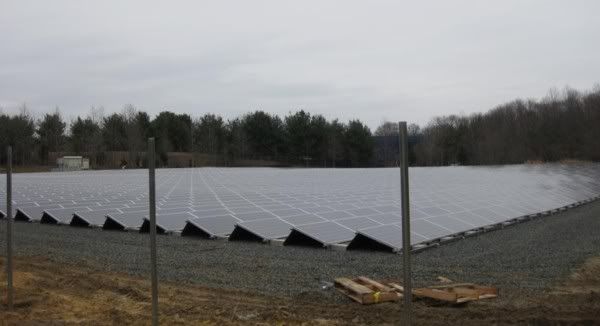
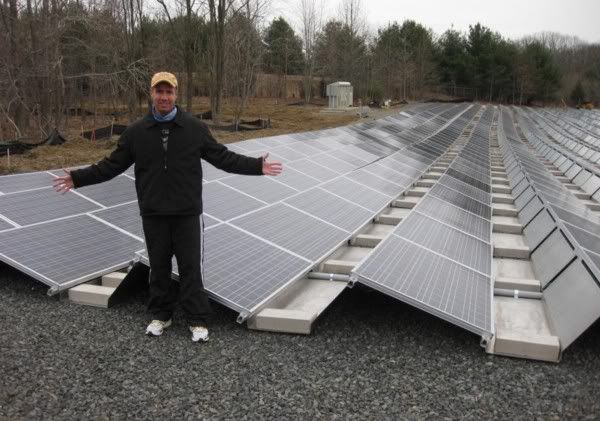
Here are some pics of a Solar Farm I came across when I was up in NJ last week.... It is to offset a local Municipality by 30% ... YEAH!!! Can't wait to get a few of these projects here in FL :-)

click on pic to enlarge

click on pic to enlarge

~~~~~~~~~~~~~~~~~~~~~~~~~~~~~~~~~~~~~~~~~~~~~~~~~~~~~~~~~~~~~~~~~~~~~~~

Bob Gentile Solar Energy Consultant with Abundant Energy Inc. www.Solar-FL.com 561.732.5181

Abundant Energy Inc. is Florida's leader in Solar Energy, celebrating 23 Years of Service.

**Solar Electric ( photovoltaic ) PV
Spin your FPL meter backwards.

**Solar Hot Water
Puts you on the road to FREE hot water forever.

**Solar Pool Heating
You can now have a warm swimming pool all year round.

Bus. Owner will earn an annual profit of $14K by selling his solar energy back to electric co.

Here is a great way for a SMALL BUSINESS OWNER to help combat a crumbling economy and still keep his doors open.

Thanks to a wealth of roof space at Mike Roach's Gainesville warehouse (owns a small mailing business with five employees), Roach will soon install nearly 100 solar panels and earn an annual profit of $14,000 by selling his solar energy back to the electric company.

The program is being hailed as a pioneering step in U.S. energy policy, one that would transfer power production from massive plants relying on coal, gas and nuclear power to individual homes and businesses using sustainable and pollution-free sunshine.

This form of distributed electricity (*Feed-In-Tariff) gives business owners an opportunity to now profit on making electricity and selling it back to Gainesville Regional Utilities. (see below on system works)

But this model has set limits on how much it will produce in the form of Solar from the ultility company, not a bad thing because in order for this to work long term it needs to set production limits.

A crawl before you walk business plan per say, and looks like the crawling has almost stopped.

Gainesville Regional Utilities (GRU) has announced that it has aleady reached its first year solar PV reservation target with this groundbreaking Feed-In-Tariff program. (first city in USA to use the Feed-In-Tariff model adopted from Germany*) The Florida municipal utility will continue accepting reservations for an additional 4 megawatts (MW) in 2010 on a first come first serve basis.

Gainesville's program went live on March 1. The 2009 solar PV tariff of $0.32/kWh for twenty years will remain in effect for 2010 reservations. Avg.normal rates people pay are around $0.11-13 cents/kwh)

*Germany, which pioneered feed-in tariffs 10 years ago and is now a world leader in solar and other renewable energies. The program has created approximately 250,000 jobs while electricity prices have only increased by about $2.50 a month for the average customer, according to the German government.

Here is how the system works: Anyone wanting to sell energy would receive two separate electric meters – one for the energy coming in and another for the energy going out. The solar energy would not be used on-site, but transferred to the grid where it mixes with the larger supply. As incentive, solar providers would be paid far more for supplying energy than the utility is allowed to sell it for.

Advocates say the benefits are threefold: More jobs, a cleaner environment and energy security.

Good news is this program has initiated conversations to roll this program out across the state of FL and beyond. Other states like MI has just rolled out a smaller type Feed-In-Program to test the model.

Thursday

Florida Solar Energy Sunshine or ummm "Clean" Coal

The Reality Adv Campaigns have called out the coal industry for their dirty lies. Just last week, the Environmental Protection Agency decided to reconsider carbon dioxide regulation -- a serious wake up call to the coal industry.

In reality, there is no such thing as "clean" coal in America today. Coal cannot be called 'clean' until its CO2 emissions are captured and stored safely.

Let's be clear: there are no US homes, factories, shopping centers or churches powered by coal plants that capture and store their global warming pollution.

Join Reality and help them push the coal industry to come clean about dirty coal.

"Air Freshener"
is directed by the Coen brothers, and we're proud to say it's Reality's latest ad -- calling out the coal industry's ridiculous claims that coal is clean as only the Coen brothers can.

Watch it now:


Thanks for watching and supporting the fight against the coal industry,

Bob
Bob Gentile Solar Energy Consultant with Abundant Energy Inc. www.Solar-FL.com 561.732.5181

Stimulus Bill changes Solar Tax Credits to outright Grants

Watch the video below to see how SOLAR and Green Energy's future will be impacted because of the stimulus bill signed by President Obama ... Good News for those wanting affordable solar here in FL and across the country.

Namaste Solar CEO Blake Jones introduces President Obama at the Stimulus Bill signing ... Blake did a good job promoting solar, mentioning the solar projects that their company had on hold and now they can move forward, lastly about the future of solar and the growth of green jobs.

Watch Short VIDEO Here

President Barack Obama signed a stimulus bill that changes those tax credits into outright grants, the Solar Energy Industries Association said the bill would allow its members to "create 67,000 jobs in 2009 alone and a total of 119,000 jobs over the next two years."

"All these renewable-energy deals were built on tax credits. Without commercial banks with tax appetite, all these deals were stopped in their tracks," said Jake Stephens, director of development for US Solar. "This was a fix to the fix."

The bill Obama signed converts those tax credits into outright grants for solar-energy projects. The State of Florida now has $95 million worth of renewable energy grants that Businesses and residential owners can take advantage to go solar. Yes now available is clean, affordable energy for you, call now to find out complete details.

Bob Gentile Solar Energy Consultant with Abundant Energy Inc. www.Solar-FL.com 561.732.5181

Sunday

FL Government waking up to this "Green" Thing- Way to Go!

Great article from Miami Herald.... Looks like FL is finally waking up to being the leader in renewable energy in the US. I am keeping my fingers crossed that it will be more than just words and they do what they say.

I look forward to working with FL to be the leader in "Going Green",

Bob

''We want to be a leader in this country in solar and wind,'' said Public Service Commission Chairman Matthew Carter. ``We want to establish a dynamic and vibrant marketplace.''

''We agree the people of Florida don't want to pay a lot for renewable energy,'' said Jerry Karnas of the Environmental Defense Fund. ``But we also know they want renewable energy and they want a lot of it so the key is how do we get the most renewable energy for the least cost.''


~~~~~~~~~~~~~~~~~~~~~~~~~~~~~~~~~~~~~~~~~~~~~~~~~~~~~~~~~~~~~~~~~
The Miami Herald
Sat, Jan. 10, 2009

Renewable energy gets push in Legislature
BY MARY ELLEN KLAS

Florida electric companies would have to rely on an increasingly heavy mix of wind, solar and biomass to generate their power over the next 11 years, under a proposed rule state regulators voted to send to the Legislature late Thursday.

Calling their decision ''historic,'' the Florida Public Service Commission unanimously voted to send the Legislature the proposal that calls for 20 percent of their fuel mix to come from renewable energy sources by 2020. They also agreed that consumers could be charged up to 3 percent more in order to jump start the market for the clean technologies.

''We want to be a leader in this country in solar and wind,'' said Public Service Commission Chairman Matthew Carter. ``We want to establish a dynamic and vibrant marketplace.''

The commission's draft rule would require that 75 percent of the renewable energy fee go to finance solar and wind production and 25 percent go to finance biomass production.

The financial incentive is needed, commissioners said, because developing these projects is expensive and they want companies to be willing to build them in Florida.

The Legislature can approve or reject the recommendation before the rule takes effect. The recommendation is only a small piece in a large and complicated debate over how to spark investment into more environmentally-friendly energy sources and reduce Florida's contribution to climate change.

The rule also recommends the following goals:

* 7 percent of the fuel used by power companies come from renewable energy sources by 2013, 18 percent by 2019 and 20 percent by 2020;

* commissioners will review the goals every three years;

* penalties for companies that fail to meet the goals;

''We have a long term commitment to it so these industries are going to come to Florida,'' Carter said. ``We're going to have jobs. Florida's going to be a leader and we may even be able to export solar technology to other states...I'm all for leading.''

The vote was a victory for Gov. Charlie Crist who first recommended the ''20 percent by 2020'' standard and won plaudits from the environmental and alternative energy industries. But PSC staff concluded last year that that wasn't achievable until 2041. Florida got 3.6 percent of its electricity from alternative energy as of 2007, the commission said.

The commission hired a private consulting company, Navigant, to conduct a thorough study and market analysis. Navigant concluded that Florida could reach at least 24 percent of its energy portfolio from renewable energy by 2020 with the right incentives.

At Crist's insistence, the 2008 Florida Legislature authorized the PSC to set the rule, but the Legislature gave itself the authority to approve or reject it. At the heart of the debate is the question of how fast Florida can develop solar and wind power at a reasonable cost to consumers and how much more to allow consumers to be charged to get the new technologies up and running.

Commissioner Lisa Edgar said that while she ''doesn't generally like carve-outs,'' it may be necessary to charge customers more money to meet the 2020 goals.

Commissioner Nathan Skop agreed: ''20 percent by 2020 is an ambitious goal and it's going to take money to get there,'' he said.

''We agree the people of Florida don't want to pay a lot for renewable energy,'' said Jerry Karnas of the Environmental Defense Fund. ``But we also know they want renewable energy and they want a lot of it so the key is how do we get the most renewable energy for the least cost.''

The commission also recommended that the Legislature exclude nuclear energy from the 20 percent requirement, something Florida Power & Light and other large utility companies fought hard to get.

© 2009 Miami Herald Media Company. All Rights Reserved.

Bob Gentile
Solar Energy Consultant
Abundant Energy, Inc. Palm Beach County Area

Office: 561.732.5181
Email: solarnow@bellsouth.net
Solar-FL.com

Thursday

Oil Price Wars

Here is a great article by Boone Pickens about the Oil Wars and why we have to stay focused on moving away our dependence on foreign oil.

~~~~~~~~~~~~~~~~~~~~~~~~~~~~~~~~~~~~~~~~~~~~~~~~~~~~~~~~~~~~~~

Oil Price Wars

We have to stay on offense! We can’t let the new Congress and the new Administration shove our dependence on foreign oil to the back burner.

Here’s why.

When we started the Pickens Plan last July, oil was at about $147 per barrel, gasoline at the pump was $4.11, and we were importing about 70 percent of the oil we use. Today oil is $100 per barrel less, but we are still importing about 70 percent of our oil.

Why is this important? Because we are still at the mercy of foreign governments and unstable areas of the world for our oil supply.

It is still a crisis, but it’s also an opportunity for us to fix it.

Look at the headlines from just the past couple of days.

- Oil up $5 on OPEC cuts.
- Russia cut off natural gas supplies to Ukraine.
- Iran calls for oil embargo for supporters of Israel.

Just before the holidays, OPEC met to try to raise oil prices. OPEC delivers 40 percent of the daily oil supply. They decided to cut their output by 2.2 million barrels per day to try and get the price back in the $70 range.

You’ve heard me tell you before that if consumption runs short of supply, then the only way to balance the books is by raising the price. What have we seen? Gasoline at the pump has jumped back over $2 per gallon in many areas and is moving back up.

Next headline: On New Year’s Day, Russia cut off natural gas supplies to Ukraine in a dispute over prices and payments.

According to Reuters news service, “That has hit natural gas supplies to countries in eastern and southern Europe facing freezing temperatures and has worried European countries, which get one fifth of their gas through pipelines that cross Ukraine.”

Think about that: The Russian government is willing to force its customers to pay whatever price it sets by cutting off supplies; not threatening to cut off supplies, but by actually doing it in the coldest part of winter.

We don’t rely on Russia for our natural gas. We don’t import any of it, and we have plenty of our own natural gas supply.

The problem comes from that second headline – what happens if Iran and other Mideast and African countries decide to use oil as a weapon against us like Russia is using natural gas as a weapon against Ukraine?

I’m not making this up. Here is what the Iranian News Agency reported over the weekend:

"Pointing at Westerners' dependence on the Islamic countries' oil and energy resources, [Iranian leaders] called for cutting the export of crude oil to the Zionist regime's supporters the world over.”

Iran understands how to leverage our over-dependence on foreign oil. OPEC understands how to manage output. We are left without any weapons in this price war.

We have to remind our leaders in Washington that whether oil is a $50 a barrel or $150 a barrel it is the level of our dependence on foreign oil, not just the price, which puts us all at the mercy of unfriendly foreign governments and you don’t know when they will move against us.

-- Boone

P.S. If you haven’t yet joined your Pickens Plan District Group, click here to join today.

Tuesday

Three Point Plan to Stimulate America's Economy

The Alternative Energy Association Announces Three Point Plan to Stimulate America's Economy

PALM BEACH, Fla.--The Alternative Energy Association, Inc., a Florida-based non-profit organization has announced its Three Point Plan to stimulate the American economy, reduce our dependence on foreign oil and create millions of new jobs.

The Three Point Plan focuses on three solutions which relate to fuel efficient vehicles, solar power and wind energy. Highlights of the plan include bailout limitations on the Big 3 American automobile manufacturers, solar and wind energy requirements for government buildings, advanced solar financing plans, and government subsidies for wind energy infrastructure.

The Alternative Energy Association is in the process of planning the creation of 50 state chapters, along with multiple college-based chapters. These state and college chapters will be charged with the responsibility of working with their state’s members of the U.S. House of Representatives and U.S. Senate, state legislatures and local governments to create legislation to accomplish these goals, on a grassroots basis.

IMPLEMENT THE ALTERNATIVE ENERGY ASSOCIATION’S 3 POINT PLAN TO SAVE AMERICA

Reduce, or eliminate, our need for foreign oil, create millions of jobs and stimulate our economy NOW by following the AEA’s 3 POINT PLAN.

Point One: Transportation. America's most immediate energy problem is a liquid fuels issue affecting the transportation sector. Bail out the Big 3 auto makers only if they agree to stop producing any passenger vehicle that does not get at least 25 mpg and give them greater incentives to build vehicles that get 40+ mpg. 60% of all daily vehicle usage in the U.S. consists of less than 30 miles of travel. Plug in hybrid vehicles use an electric motor for travel up to 40 miles before the gasoline engine kicks in, which reduces gasoline usage so that some vehicles can even get up to 100 mpg. BUT, we are still using foreign oil. By using existing technology, not unproven theory, we can create plug in hybrids that run on electricity and domestic natural gas, not gasoline made from foreign drilled oil. Today we have a supply of 118 years worth of natural gas in America. Follow this plan and there will be enough natural gas for 300 plus years – and no foreign oil will be used. Stop sending $600 billion to $1.5 trillion out of the U.S. every year.

Point Two: Solar. One-half of all solar panels manufactured in the world go to Germany. Why? Because of German feed-in-tariff legislation that makes it financially beneficial for homes and businesses to install solar equipment. Eight U.S. states are contemplating similar legislation, and a local variety of this plan is being implemented in Gainesville, Florida. Make Congress pass federal legislation mandating the same plan and provide financing to new solar panel manufacturers. Widespread use of solar will create millions of jobs in the U.S. in manufacturing, installation, and maintenance. Use of solar in federal and state buildings should be mandated NOW, so that government leads the way. Extend the 2008 Economic Stimulus Act provisions that provide tax incentives for commercial solar and implement the financing plan used by some municipalities to help finance solar for residential use. Create government loan guarantees like the ones used by the Small Business Administration to finance solar equipment.

Point Three: Wind Power. The wind corridor from New Mexico/Texas north through the Dakotas can produce enough wind power to generate electricity not only for all of the United States, but for all of Canada and Mexico. Wouldn’t it be nice to export power for a change? Wind power infrastructure will also create millions of jobs in the U.S. and must be built to distribute the power throughout the country. This is the world’s cheapest and fastest-growing new energy source, along with being clean and renewable. Make Congress provide incentives for wind power infrastructure the way it did for the telecommunications infrastructure and the way it provided subsidies to oil companies for decades.

The Alternative Energy Association is in the process of planning the creation of 50 state chapters, along with multiple college-based chapters. These state and college chapters will be charged with the responsibility of working with their state’s members of House and Senate, state legislatures and local governments to create legislation to make this happen on a grassroots basis.

For those desiring to learn more about energy issues and possible solutions to our energy situation, download the AEA's free publication “The Energy Revolution – 277 Things Every American Needs to Know About the New Energy Paradigm” at http://www.alternativeenergyassn/freeenergyrevolution.html

Article from www.alternativeenergyassn.com/home.html

Bob Gentile Solar Energy Consultant, Abundant Energy Inc. www.Solar-FL.com

Sunshine "rising" State towards clean energy & it's time!!

Florida could create more than 120,000 new jobs by investing in clean energy.

Gov. Charlie Crist last year launched Florida's efforts to control carbon. He called for the state's utilities to get 20 percent of their electricity from renewable energy by 2020 and proposed a carbon cap-and-trade system to reduce the state's greenhouse gas emissions.

Obama's energy proposals

• Help create 5-million new jobs by investing $150-billion over the next 10 years to boost private efforts to increase clean-energy production.

• Within 10 years, save more oil than the United States currently imports from the Middle East and Venezuela combined.

• Put 1-million plug-in hybrid cars — cars that can get up to 150 miles per gallon — on the road by 2015.

• Ensure 10 percent of the country's electricity comes from renewable sources by 2012, and 25 percent by 2025.

• Implement an economywide cap-and-trade program to reduce greenhouse gas emissions 80 percent by 2050.

Bob Gentile Solar Energy Consultant with Abundant Energy Inc. www.Solar-FL.com

Monday

No you did not say it's a NO Brainer?!! Did you?

Is what I said to the prospect during my Presentation last week...

He said "Yup Bob this is a NO Brainer" Well being that the customer is always right, I agreed with him :-) as we set up an installation date.

(Below is what we went over as I was breaking down the investment of a Solar Hot Water System)

Now I believe as a Solar Energy Consultant for Abundant Energy, Inc. that Solar Hot Water is one of the VERY best ways to lower your electric bill. I believe it truly is a "No Brainer" for many homes in FL, not all but for a large majority. So while I will never say that directly to the prospect, it's really nice to hear them say "It's a No Brainer Bob" :-) (hence the reason for this post)

I Hope the information below at least gives you some more insight on the benefits of a Solar Hot Water System and why many Floridians are moving towards FREE Hot Water "CLEAN Sunshine Energy" every day.


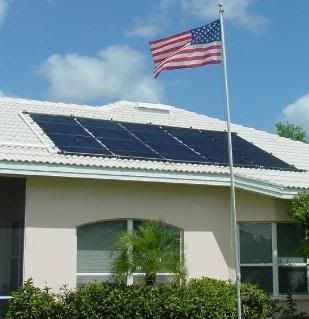
Solar Hot Water collector on a Palm Beach County Home

~~~~~~~~~~~~~~~~~~~~~~~~~~~~~~~~~~~~~~~~~~~~~~~~~~~~~~~~~

How can I pocket up to $16,200 over the next 20 years?

The $16,200 is an estimate using the current information we have collected from government sites. This is not a promise and might not apply in your particular circumstances.

How did we calculate that?

The yearly electricity avg. savings are between $600 and $960 - (monthly $50 - $80 (Source: Department of Environment and Natural Resources).

The Environmental Protection Agency estimates the life of a solar hot water system to be between 15 and 20 years.

So in an ideal scenario, you could save $960 per year x 20 years, which is $19,200. We can install a solar hot water system on avg. $2,000 - $3,000 (after rebates and depending on your location and needs). Deducting the roughly $3,000 off the $19,200 leaves a potential profit of $16,200.

How else could you calculate it?

As you can see this calculation is the ideal scenario. Assuming that only $600 are saved per year ($50 per month) and the system lasts 15 years, the total savings would be $9,000. There are systems that might cost around $4,000 fully installed (again after rebates). Only a profit of $5,000.

So this scenario is not as profitable. What we have NOT considered is the NEVER ENDING rising
electricity prices. (FPL latest increases total 19% from August, 2008 to January 2009). So obviously your profits will be higher.

Thinking further

However, even in this most negative scenario, you are still better off getting a solar hot water system than not doing anything - just financially. Taking the environmental impacts into account: 3,000 kg of CO2 saved each year (25% of household greenhouse co2 emissions) makes it an excellent proposition and good example for kids & grand-kids.


How long does a Solar Water Heater last?


No one can give an exact estimate of how long a solar water heater lasts. Just the same as for any other technical appliance.

However, here is what the Environmental Protection Agency says about solar water heater lifespans:

“A solar hot water system normally lasts 15 to 20 years, which is up to double the life of an electric system. They are a well-proven product and have experienced substantial development over the past decade, with newer models expected to last even longer.”

According to Sue Roaf, author of “The Ecohouse 2 - A Design Guide” (Architectural Press, 2003) writes:
“A good liquid solar collector should have a life expectancy of 20-30 years. Most of the collectors built since 1980 are manufactured with materials that should give a 30-50 year lifespan.”

What follows is that the tank might need replacement before the collectors. As they are two separate pieces only connected by plumbing, it is quite simple to do that.

The owner from Abundant Energy Inc. is going on his 18th year of his Solar
Hot Water
System. Yes, That's a lot of FREE Hot Water.
~~~~~~~~~~~~~~~~~~~~~~~~~~~~~~~~~~~~~~~~~~~~~~~~~~~~~~~~~~~~~~~~~~~~
For more info. about Solar Hot Water contact Bob Gentile 561.732.5181 from Abundant Energy, Inc. Find out if a Solar Energy System makes sense for your home and or business.

Thursday

You have options to lower Electric Bills -Benefits of Solar Hot Water

You don't really have a choice when it comes to increases, Like you Water & Sewer Bill, Trash Removal, Basic Cable, Home Owners Association fees etc... You just have to Pay the increased rates... and cut back in other areas like going out to Dinner less, staying home on your two week vacation, try to carpool more to cut back on gas costs.

Well GOOD NEWS with your Electric Bill, You DO have Options to combat the never ending increases from FPL.(see latest increases here)

The very best way to LOWER your electric bills immediately is to part ways from that "ENERGY HOG" called your "Electric" Hot Water tank and move over to a Solar Hot Water system... You will save $70-$90 per month immediately ($80 x 12 months = $960 x 5 years is almost $5000 and that doesn't factor in any FPL increases, so it's actaully way over $5000 and probably closer to $6000.

When you invest in a Solar Hot Water System it puts you on the road to FREE Hot Water with a payback of 2 - 3 years and we all know how fast the years go bye....bye :-(

The Benefits to you:
  • Reduce your energy bills by 30%
  • Environmentally friendly
  • Make a difference by helping to reduce greenhouse emissions by reducing your dependency on your electric or gas water heater
  • Add Value to your home and if you sell your home, It's Nice to say "THIS HOUSE has FREE Hot Water". A way better upgrade then new carpet & fresh paint, even though that helps as well.
  • Extends the expected life of your residential hot water tank.
  • Qualifies for the 30% Federal Tax Credits

A Solar Hot Water System from Abundant Energy, Inc. is a great way you can offset the never ending increases. An average savings with Solar Hot Water per month is $70-$90, your payback is 2-3 years.

After that you can say “I have FREE Hot water”


~~~~~~~~~~~~~~~~~~~~~~~~~~~~~~~~~~~~~~~~~~~~~~~~~~~~~~~~~~~~

For more info. about Solar Hot Water contact Bob Gentile 561.732.5181 from Abundant Energy, Inc. Find out if Solar makes sense for your home or not

Friday

Profit on Solar?!Could be some Amazing news FL Residents & Businesses

Gainesville Considers German Solar Tariff
In a move that would emulate Germany's feed-in tariff, a utility in Gainesville, Fla., could become the first to pay residents and businesses for solar power.
by: Jennifer Kho October 14, 2008

Gainesville, Fla., is poised to become the first U.S. city to adopt incentives similar to the ones that made the German solar market the largest – by far – in the world.

Gainesville Regional Utilities has drawn up a plan for a feed-in tariff, in which it would buy all the electricity that solar-power systems generate for a set rate guaranteed for 20 years from the time a project is installed.

The plan would pay 26 cents per kilowatt hour, according to Mike Antheil, acting director for the Florida Alliance for Renewable Energy.

While California already has a feed-in tariff, for instance, it only allows residents to offset their electricity bills – not to make money if they sell more power than they use.

"This is really a historic moment," Kellyn Eberhardt, an associate with the Environmental Defense Fund, told The Gainesville Sun. "This is the first time in North America that a municipally owned utility is considering a feed-in-tariff policy."

At the Solar Power International conference in San Diego on Tuesday, Roy Ratner, director of operations at Atlas Solar Innovations, also said it's an important step.

"This is very exciting," he said. "This could be the catalyst for big change. ... Policy has to come before everything."

According to the Sun, city commissioners on Monday asked the utility to draft an ordinance to try to get the tariff passed as early as Jan. 1.

The move means the tariff is very likely to pass, Antheil said.

"Once the commissions say to draft that up, it's pretty much a done deal," he said. "Business as usual, these are the formal steps we have to go through. But once the first step begins, it usually pretty much follows like dominoes and this is what we'd like to see here."

He said he has no doubt this will not only go through, but it will spark movement in the rest of Florida.

"Nobody wants to be left in the dust on something like this," he said. "This is going to spark an almost 'Don't be left behind' thing among the different cities and municipalities. I think this is a great move for Florida. It's a phenomenal start."

While he isn't certain about the Gainesville tariff, which seems to target solar power specifically, Antheil said his group hopes more renewable-energy sources will be included in future plans and in other areas. He also expects most tariffs will decrease over time to push costs toward competitiveness with traditional energy sources.

According to the Sun, the Gainesville feed-in tariff would end the current cash rebate of $1.50 per watt for solar-electric panels and also would eliminate a program that turns customers' meter backwards when they feed power into the grid.

The cost of the program would be distributed among customers as an increase in the utility's "fuel adjustment rate," which is determined by the amount the utility spends on coal and natural gas each month, The Gainsville Sun reported.

If the program results in the installation of 1 megawatt of solar equipment each year for the next 20 years, customers would see a rate increase of less than 1 percent per customer by 2029, according to the utility.

Large incentives have the tendency to be more successful than expected (see Big Renewable-Energy Subsidies Backfire).

But Antheil said even in Germany, the largest solar market today, the tariff costs customers the equivalent of a load of bread – some $2 to $3 – per month.

"This is a spark that is going to create competition amongst the different municipalities and show Florida that right now, we have an opportunity to lead the rest of the country when it comes to job creation, energy independence and environmental stewardship," he said. "We have the chance to set the roadmap, to create the blueprint. I hope Gov. Crist and the rest of the municipalities take the opportunity to launch us onto the world stage in this area."

Few examples of local increases in Palm Beach

Here are just a few examples of local increases in Palm Beach County which you don’t have much control of, you just have to pay it and find other ways to cut your costs.

Palm Beachers turn up noses at West Palm Beach water
By WILLIAM KELLY Palm Beach Daily News Staff Writer Tuesday,
October 07, 2008


Nine out of 10 said they oppose the 48 percent water rate hike that appeared on their July bills. That increase was in addition to four planned hikes, of 9.75 percent each, on Oct. 1 of this year, 2009, 2010 and 2011, the city said in April. The city said the higher rates are needed to make up for revenue lost to reduce water usage because of drought-related watering restrictions.

READ THEIR LIPS: NO BOCA TAX INCREASE, BUT….
Sunday, September 28, 2008

There will be additional fees including $5 per month trash fee, $10 increase in fire assessment fee for homeowners, water and sewer rate increase of 5.8% and 2% water and sewer electricity surcharge. The new library project has been moved to the 2009-2010 fiscal year in the city’s capital improvement budget. Beginning the library now, the city manager said, would cause next year’s tax to go up by 2%, counting debt service and library operations.

DELRAY BEACH: Water rates to rise $5-$6
September 22, 2008


Effective Oct. 1, water prices will increase, with the average customer paying $5-$6 more per month. Officials point to the higher cost of chemicals to treat water and a reduction in use for the rate increase. Handling sewage also got more expensive. The rate will go from about $33 a month to about $35 depending on how much water you use. Sewage fees will go up to $51 per month from $45. Garbage and trash collection will rise from $3.06 to $6.14; recycling from $1.67 to $2.50; and yard trash from $2.13 to $2.50.

A Solar Hot Water System from Abundant Energy, Inc. is a great way you can offset the never ending increases. An average savings with Solar Hot Water per month is $70-$90, your payback is 2-3 years.

After that you can say “I have FREE Hot water”


~~~~~~~~~~~~~~~~~~~~~~~~~~~~~~~~~~~~~~~~~~~~~~~~~~~~~~~~~~~~

For more info. about Solar Hot Water contact Bob Gentile 561.732.5181 from Abundant Energy, Inc. Find out if Solar makes sense for your home or not.

Wednesday

FL projected increase in your electric bill now Nineteen %

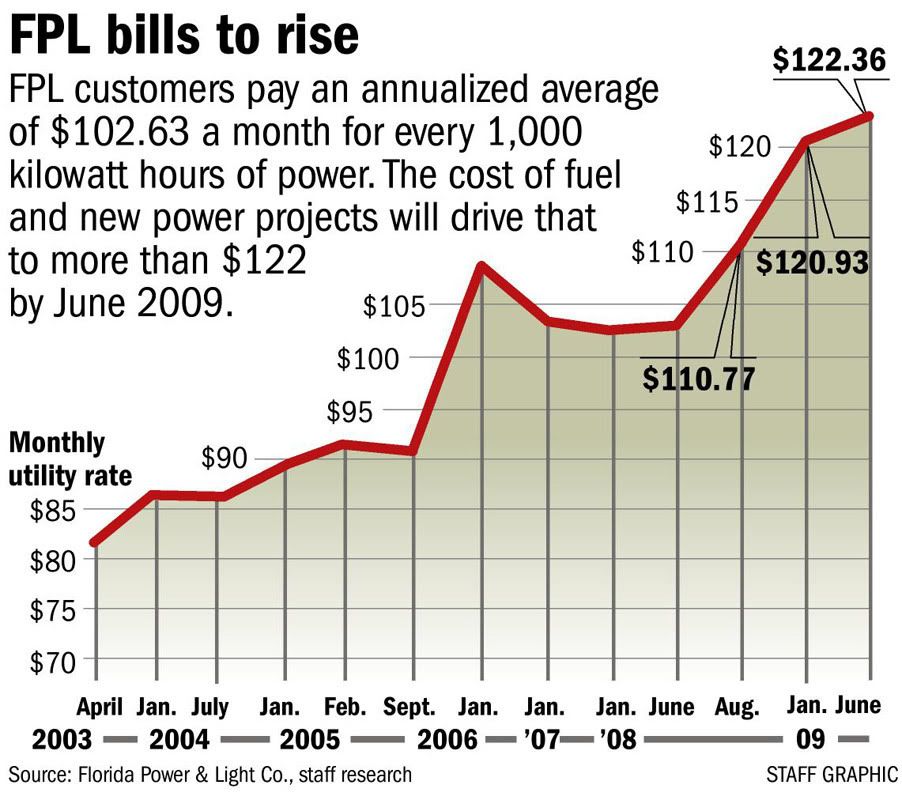
Here is what to expect by June 2009' not good ... 19% increase

August: The typical 1,000-kilowatt-hour monthly bill will increase about 8 percent, from $102.63 to $110.77.

January: The 1,000-kilowatt-hour bill will jump another 9 percent to $120.93, with $2.51 of the increase going for FPL's nuclear plant expansions.

June: The 1,000-kilowatt-hour bill will increase to $122.36, including the $2.51 nuclear charge and $1.43 for the West County Energy Center's Unit 1 near Loxahatchee.


Click on pic to enlarge FPL Rate Increases Chart from 2003- 2009

It's time to look into Solar more closely... please email or call to see if a solar system makes sense for your budget or not.

Sincerely,

Bob Gentile
Solar Energy Consultant
Abundant Energy, Inc.
Office: 561.732.5181
Email: solarnow@bellsouth.net

"There are two primary choices in life: to accept conditions as they exist,
or accept the responsibility for changing them." ~ Denis Waitley

Friday

Solar power's popularity is heating up -

Solar power's popularity is heating up - Daytona Beach News-Journal

ORMOND BEACH -- Solar power technology, once exclusively used for hot water heaters and raising the swimming pool temperature a few degrees, is now powering homes, may soon power cities and may even be collected from outer space.

"The technology has been around for 25 years or so," said Andy Barbaro, vice president of Wayne's Solar. "What's made it more popular is the increased efficiency, and the rising cost of electricity has made it more affordable. It's not for the millionaires anymore. But what's really driving the increase here are the state rebates and federal tax credits. They can pay for almost half the cost."

Installing thermal solar panels was Wayne Phillips' main business for more than 25 years, along with other solar businesses in Volusia and Flagler counties. But, about half of Phillips' business now is installing solar electric panels -- known as photovoltaic cells -- to provide homemade electricity. Business is up about 30 percent from last year.

"Building homes with pools was big business around here for a long time, but that is hurting now," Phillips said. "The solar electric panels have really taken off in just the last year and a half."

Thermal solar panels have been used in Florida since the 1940s to heat water for showers and washing the dishes. Larger systems were designed to heat pools to extend the swimming season a few months. The panels functioned like a radiator. Water, either stored on or pumped to the roof, runs through a set of tubes heated by the sun.

Solar pool heaters still function the same way, but home water heaters have improved through the years where hot water can be stored in heaters with computerized sensors regulating when water is sent to the roof collector for heating -- usually during the day when the sun is shining.

The early solar water-heating systems are intended to save homeowners money, but they can cost money, Barbaro said. If water is taken from the ground at 72 degrees and run through rooftop pipes during cooler night temperatures, the water must be reheated, using conventional electricity.

A new home solar water-heating system costs between $2,000 and $2,800, but could reduce electrical bills 20 to 30 percent, he said.

The popularity of solar electric systems has also created new jobs because licensed contractors must install the systems for a homeowner to be eligible for rebates and tax credits. The number of persons sitting for contractor classes and tests is soaring, said Bruce Kershner, executive director of the Florida Solar Energy Industries Association.

"The numbers have gone from less than a 10 a year to a couple hundred this year. You would not see an increase like that unless there is a demand," he said.

Roof-top mounted solar electric panels can reduce electrical bills from 30 to 80 percent depending on the number of 3-by-5 foot photovoltaic panels. System costs start at about $8,000 for a minimal 2,000 watt system that generates 2 kilowatts an hour when the sun is shining. It may take eight or more years of savings off the electrical bill to pay for the installation.

However, with the rebates, a 25-year warranty on panels that may last 40 years, the economic benefits are obvious, Barbaro said.

Lou and Judy DePaul of Ormond Beach initially got a thermal water heater about a year ago and then recently added a large solar electric system to their 1,800-square-foot home.

""We liked the results from the water heater, so we added the electric," Judy said. ""We saw a $35 electric bill the first month. We love it."

To encourage more use of renewable energy, Florida started a solar rebate program in 2006. The legislature approved $3.5 million last fiscal year and $5 million this year.

Homeowners can get a solar electric rebate of $4 a watt up to $20,000. A commercial project could see a solar electric rebate up to $100,000. Rebates of $500 a home and $5,000 a business are available for thermal water heaters and $100 for a home pool-water heater.

A swarm of applications exhausted last year's pot. This year's money paid off last year's waiting list and was quickly exhausted. A new list is developing. The program is slated to expire in 2010.

Federal incentives provide $2,000 tax credits for solar electric and thermal water heaters, but none for pool heaters. That program expires at the end of the year and renewal has been difficult. Congress has failed eight times to pass a new bill.

Progress Energy provides a $450 credit to offset the purchase of a solar water heater. Florida Power & Light does not have a rebate program.

""Solar struggled for years with pool heaters and some hot-water heaters," Kershner said. "Rebates and tax credits make it more cost effective. If we don't have the tax credits extended and adequate money for rebates, it will severely cripple the industry. Any renewable energy source is expensive to provide and it needs time and incentives for it to be successful."

Most solar electric panels do not provide all of a home's electrical needs. That would require many batteries and be costly, Barbaro said. Instead, he looks to reach the rebate levels and then work with customers to tailor a system. However, during peak electrical generating periods -- bright sunny days while the homeowners are at work -- the system could be adding power to the electrical grid and be making money for the homeowner as power companies are required to buy the surplus power at retail prices.

While most solar energy equipment retailers are focused on retrofitting existing homes with thermal and electrical systems, a few homebuilders are starting to make solar systems optional amenities to new homes. It's cheaper to add the systems during construction.

Shea Homes builds "green" homes in the Victoria Gardens section of Victoria Park in southeast DeLand. Solar-powered attic fans, dual-pane windows and motion/occupancy sensor lighting are standard features. The California-based company also is offering solar electric systems to new homeowners, even a free $30,000 package through Aug. 31.

"We have been building green for a long time. This is just an extension of our green efforts. It just makes sense as the next step," said Jeff Gersh, Shea Homes area vice president. "It also brings added awareness to the benefits of solar technologies."

For some, the goal is to build a self-sufficient solar powered home.

Progress Energy has teamed with the Florida Solar Energy Center at the University of Central Florida Brevard campus and Palm Harbor Homes to build a manufactured home with a roof outfitted with solar electric panels. The program wants to combine the efficiency of mass produced housing with advances in photovoltaic-panel technology.

The team is studying the six homes it built in 2001 and placed around the coastal county.

Progress Energy and Florida Power & Light are working on larger projects as well to reduce the use of coal, natural gas and oil.

Last month, a state agency approved a $17 billion plan for the company to build two nuclear power reactions in Levy County with the hope of having them operational by 2017.

FPL at the same time gained permission to build three solar power facilities for $688 million in Brevard, Martin and DeSoto counties. The plants would produce 110 megawatts (110,000 kilowatts). When the announcement was made, the plants would generate the most power from the sun and would power about 35,000 homes.

That changed last week when California-based companies Sunpower and Optisolar announced plans to build two solar plants to produce 800 megawatts of power. That is equal to a small nuclear or a large coal plant. It is 10 times the amount of power from any existing solar power plant. It would power 239,000 homes.

The debate over solar and other none-oil based power system has grown to be one of the top issues in this year's presidential campaign.

But solar power dreams are limited to the planet.

Collecting solar power in outer space, where there are no clouds and the sun shines all the time, was considered during the 1970s by NASA and the Department of Energy. Costs were prohibitive then, but as the cost of energy continues to climb, it is becoming more of a possibility.

The major hurdle, along with getting to and working in space, is how to transmit the collected energy to earth, according to Pravna Mehta, director of India operations for Space Island Group, a company developing solar satellites.

"The cost of energy is not going down, that's for sure," Barbaro said. "Every little bit helps."

Payoffs Energize Solar Power

$2,000-$2,800 Cost of a new home solar water-heating system

20%-30% Percentage that electric bills can be reduced by solar panels

$8,000 and up Cost to install roof-mounted solar panel system

8 years + For roof-mounted system to pay off

30%-80% Percentage that electrical bills can be reduced with roof-mounted solar panels

Florida Rebate Program

Florida started a solar rebate program in 2006, which expires in 2010.

Up to $20,000 Rebate for Florida homeowners at $4 a watt

Up to $100,000 Rebate for Florida business owners

$500 Rebate for home thermal water heaters

$5,000 Rebate for business thermal water heaters

$100 Rebate for a home pool-water heater

$2,000 Federal tax credits for solar electric and thermal water heaters (program expires this year)

Monday

New Study Shows Extending Solar Tax Credits Will Create Jobs....

New Study Shows Extending Solar Tax Credits Will Create Jobs, Increase Investment
If Congress Passes Bill, 440,000 permanent jobs will be supported by the U.S. solar energy industry by 2016.

Sept. 15, 2008
WASHINGTON, Sept 15, 2008 /PRNewswire via COMTEX/ -- A new economic study issued today by Navigant Consulting, Inc., shows that more than 1.2 million employment opportunities, including 440,000 permanent jobs, and $232 billion in investment would be supported in the U.S. by the solar energy sector alone through 2016 if Congress extends the solar investment tax credit (ITC) for 8 years.
"By extending the solar investment tax credits, Congress can provide an immediate boost to the floundering U.S. economy by creating hundreds of thousands of jobs and injecting billions of dollars of new investment capital into the economy, while at the same time driving down energy costs for consumers," said Rhone Resch, president of the Solar Energy Industries Association (SEIA), based in Washington, D.C. "The solar energy industry creates jobs that are the foundation of our economy -- jobs for manufacturers, construction workers, engineers, roofers, electricians, and plumbers. These jobs are needed now and Congress is in a position to extend the ITC and ensure that these jobs are created here in the U.S."

According to the study, by 2016, the solar energy industry would create 440,000 permanent U.S. jobs with much of the direct growth occurring in domestic manufacturing, construction and the trades. This figure reveals the strength of the solar job creation engine when compared to the current 79,000 direct employees of the coal mining industry and the 136,000 direct employees in oil and gas extraction.
"There is the potential to create significant U.S. employment and investment opportunities," said Jay Paidipati, Managing Consultant at Chicago-based Navigant Consulting, Inc. "An 8-year extension of the ITC would allow the market to maintain or possibly exceed its current growth rate."
Because solar energy components are manufactured near its markets, extending the ITC would create manufacturing and installation jobs in all 50 states. The states that would enjoy the largest economic boost are California, Florida, Arizona, New Mexico, Nevada, New Jersey, Massachusetts, New York, Oregon, and Washington.

Similarly, the economies of Pennsylvania, Michigan, Ohio and the rest of the Great Lakes region would grow significantly from solar energy if Congress passes the ITC extension. This area of the country has suffered greatly from a huge decline in jobs in the automotive and traditional manufacturing industries.
"In the next week Congress will be voting on energy tax legislation and we strongly urge Congress to seize this opportunity to extend the solar investment tax credit for 8 years now before leaving for the campaign trail," said Resch.

Copyright (C) 2008 PR Newswire. All rights reserved